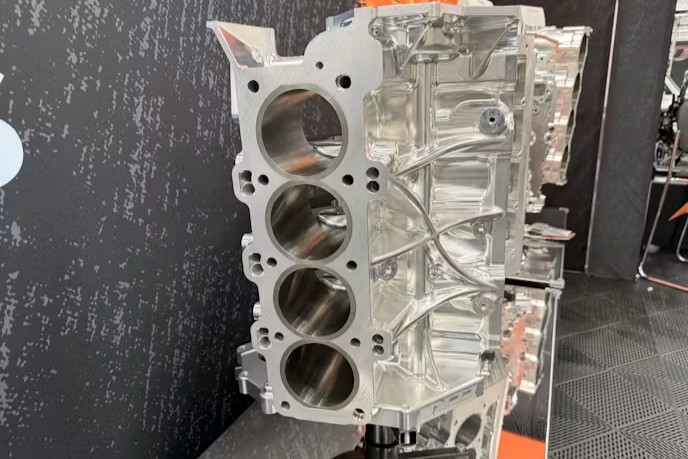
The Dawn of a New Era: Unleashing 3000HP with the Billet Coyote Block
The world of drag racing is a relentless pursuit of speed, where every fraction of a second and every horsepower matters. For years, the Ford Coyote platform, renowned for its surprising strength in stock form, has pushed boundaries. However, as tuners began to coax upwards of 2,000 horsepower from these engines, the inherent limitations of the factory cast aluminum block became evident. Physics, as they say, eventually wins, leading to catastrophic failures under extreme loads.
This challenge birthed an engineering marvel: the Billet Coyote Block, a collaborative masterpiece by Ford Performance Racing Engines (FFRE) and Noonan Race Engineering. This isn't just an aftermarket part; it's a fundamental reimagining of the Coyote architecture, transforming it into a veritable Billet Rocket designed to withstand and conquer the forces generated by 3,000+ horsepower. Its capabilities were spectacularly showcased when Brett LaSala's iconic "Snot Rocket 3.0" shattered expectations, clicking off an astounding 5.97-second quarter-mile pass at 241 mph – a monumental achievement that cemented the Billet Coyote Block's status as the new gold standard for extreme competition.
The need for such an extreme solution became clear as racers pushed stock and even reinforced OEM blocks into the 3-second eighth-mile territory. At these power levels, the main webbing of the stock block, despite its initial toughness, simply couldn't cope with the immense stress, torsion, and vibration, leading to fracturing. The FFRE/Noonan Billet Coyote Block was developed specifically to overcome these weaknesses, providing a foundation sturdy enough for world records.
Engineering Fortification: Why the Billet Rocket Defies Physics
What makes the FFRE/Noonan Billet Coyote Block, often affectionately referred to by enthusiasts as the ultimate Billet Rocket for Ford applications, so incredibly robust? The answer lies in meticulous design and cutting-edge manufacturing techniques applied by Noonan, a company with a formidable reputation for building 4,000-horsepower Pro Mod engines. They didn't just reproduce the Coyote block in billet; they optimized it for unparalleled strength.
Key design innovations include:
- External Gusseting and Organic Shapes: Barry Petit from Noonan highlighted the strategically machined organic shapes within the valley and along the sides of the block. These aren't merely aesthetic choices. They serve as external gusseting, providing critical rigidity that prevents the block from twisting or deforming under the brutal torque and power pulses of a high-horsepower engine. This added stiffness is paramount in maintaining geometric stability of the rotating assembly.
- Optimized Main Webbing: The radius in the main webbing – a common failure point in stock blocks – has been significantly opened up. This design change distributes stress more effectively, reducing localized stress concentrations that lead to fractures. It's a subtle but profoundly impactful alteration that dramatically increases the block's integrity.
- Aluminum Main Caps: Departing from cast iron, the Billet Coyote Block utilizes aluminum main caps. This choice offers superior thermal expansion characteristics that better match the block material, leading to more consistent bearing clearances and reduced stress on the main journals as the engine heats up and cools down. This thermal management is crucial for longevity in extreme conditions.
- Solid Block Construction: It's vital to understand that this is a "solid" block, meaning it lacks traditional water jackets for coolant. This design choice sacrifices streetability for maximum structural integrity, making it strictly a competition-only piece. Removing the water passages allows for significantly thicker cylinder walls and webbing throughout, turning the block into a monolithic structure capable of handling incredible cylinder pressures. This uncompromising design is a hallmark of truly dedicated racing components.
This level of engineering means that the FFRE/Noonan Billet Coyote Block isn't just stronger; it's *smarter*. It anticipates and mitigates the stresses that would disintegrate lesser engines, offering a bulletproof foundation for extreme performance. For an in-depth look at the specific features that make this block a game-changer, check out our article: Snot Rocket's 5-Second Secret: The FFRE Noonan Billet Coyote Block.
Snot Rocket's Baptism by Fire: Proving the Billet Rocket's Mettle
The ultimate test for any high-performance component isn't on a dyno, but under the punishing conditions of real-world racing. For the Billet Coyote Block, its baptism by fire came in the form of Brett LaSala's "Snot Rocket 3.0." This iconic bright green Mustang, with its unmistakable low-slung drag 'n drive stance and exposed twin-turbo plumbing, has earned a formidable reputation as one of the most decorated street/strip machines in existence.
At the World Cup Finals, Snot Rocket 3.0 didn't just compete; it dominated. LaSala and his team, confident in the car's 240+ mph potential, had a clear goal: break into the 5-second barrier. And break it they did, with a blistering 5.979-second pass at 241.37 mph, backed by a razor-sharp 1.084-second 60-foot launch. This wasn't a fluke; it was the culmination of years of relentless refinement and a direct testament to the unseen hardware keeping the engine together – the FFRE/Noonan Billet Coyote Block.
The Snot Rocket 3.0 served as the primary testbed for this groundbreaking design. With its Coyote combination producing well over 2,900 horsepower, the block was pushed to its absolute limits, consistently demonstrating immense strength and significant headroom. The fact that this "street-capable" machine, which famously won Sick Week 2025 by driving between tracks under its own power, could withstand such power output and record-setting runs speaks volumes about the Billet Rocket's dual-purpose resilience. It proved that the block could survive and thrive under conditions that easily exceeded its predicted performance capabilities, firmly establishing it as the new benchmark for extreme Coyote power.
The Investment in Unrivaled Performance: Is the Billet Rocket Block for You?
With such extreme capabilities, it's clear that the FFRE/Noonan Billet Coyote Block isn't for every enthusiast. This highly specialized component is squarely aimed at heads-up racers, professional teams, and dedicated record-chasers who demand the absolute maximum from their Coyote platform. If your goal is to compete at the highest levels of drag racing, pushing beyond 2,500 and even into the 3,000+ horsepower realm, then this Billet Rocket is precisely what you need.
Priced at just under $16,000, the initial investment might seem substantial. However, when viewed through the lens of high-stakes competition, the cost-benefit analysis quickly shifts. As the reference context rightly points out, considering that this block survived a 3.96 eighth-mile blast in a heavy door car – a feat that would likely shatter a lesser engine – it's often significantly cheaper than constantly replacing blown stock or semi-prepared blocks every other race weekend. For serious competitors, it represents an investment in reliability, consistency, and the peace of mind required to chase records without fear of catastrophic failure.
Furthermore, the block features a standard deck height and accepts all OEM components, meaning you don't have to "reinvent the wheel" with custom parts for your rotating assembly or cylinder heads. This thoughtful design simplifies the build process, making the transition to a billet platform more accessible for experienced Coyote builders. Conversely, for those looking for a robust street car that can handle significant power and idle in traffic, FFRE still recommends their Predator Stage 3+ package, which retains water jackets for street use. For a deeper dive into the value proposition, read: Gold Standard Billet Coyote Block: Is It Worth $16,000 for Drag Racers?
Beyond the Block: Building a 3000HP Billet Rocket Monster
While the Billet Coyote Block provides an unshakeable foundation, achieving and sustaining 3000+ horsepower requires a holistic approach to your entire build. The block is the heart, but a host of other meticulously chosen and perfectly tuned components are essential to create a true Billet Rocket monster. Here are critical areas to consider:
- Forced Induction System: At these power levels, twin-turbochargers are the go-to choice for their ability to generate massive boost. The turbo selection, sizing, wastegates, blow-off valves, and intercooler system must be perfectly matched to the engine's displacement and target horsepower.
- Fuel System: Delivering enough fuel is paramount. This means high-capacity fuel pumps (often multiple), large injectors, dedicated fuel lines, and a robust fuel pressure regulator. Often, alternative fuels like methanol or E85 are used for their cooling properties and knock resistance.
- Engine Management (ECU) and Tuning: A highly capable aftermarket ECU is non-negotiable. Professional tuning by an experienced specialist is crucial to extract maximum power safely, managing ignition timing, fuel delivery, boost control, and protecting the engine.
- Drivetrain: All that power needs to be reliably transferred to the wheels. This necessitates a race-spec transmission (e.g., a Powerglide or TH400), a reinforced driveshaft, a strong rear differential (often a Ford 9-inch), and heavy-duty axles capable of handling brutal launches.
- Cooling System for Solid Blocks: Since the billet block lacks water jackets, external cooling solutions are essential for drag racing. This often involves a dry sump oil system that also acts as a coolant, running specific coolants through the heads, or even direct injection of refrigerants. Managing heat between passes is critical.
- Chassis and Suspension: A robust chassis, roll cage, and dedicated drag racing suspension setup (coilovers, control arms, sway bars) are necessary to put the power down efficiently and safely.
- Safety Equipment: At 240+ mph, safety is paramount. NHRA/IHRA-approved safety equipment, including fire suppression systems, harnesses, and driver gear, is mandatory.
Building a 3000HP engine is a symphony of components working in perfect harmony. The Billet Coyote Block ensures the core can endure, but every other piece must be just as capable to ensure reliability and record-setting performance.
Conclusion
The FFRE/Noonan Billet Coyote Block marks a pivotal moment in the evolution of the Ford Coyote platform. It transforms an already potent street engine into a legitimate 3,000+ horsepower contender, capable of rewriting record books. Through meticulous engineering, strategic material choices, and a dedication to overcoming the inherent limitations of conventional blocks, FFRE and Noonan have crafted a true Billet Rocket – a competition-grade foundation that allows racers like Brett LaSala to push boundaries thought impossible just a few years ago.
While it carries a premium price tag and is designed exclusively for the brutal demands of heads-up racing, its value is undeniable for those chasing the ultimate quarter-mile times. It's more than just an engine block; it's a statement of intent, a commitment to unparalleled performance, and a testament to what's possible when expert engineering meets the unyielding pursuit of speed. For the elite few who dare to reach for the 5-second zone, the Billet Coyote Block is not just an option – it's the only choice.